
When Agents Rule
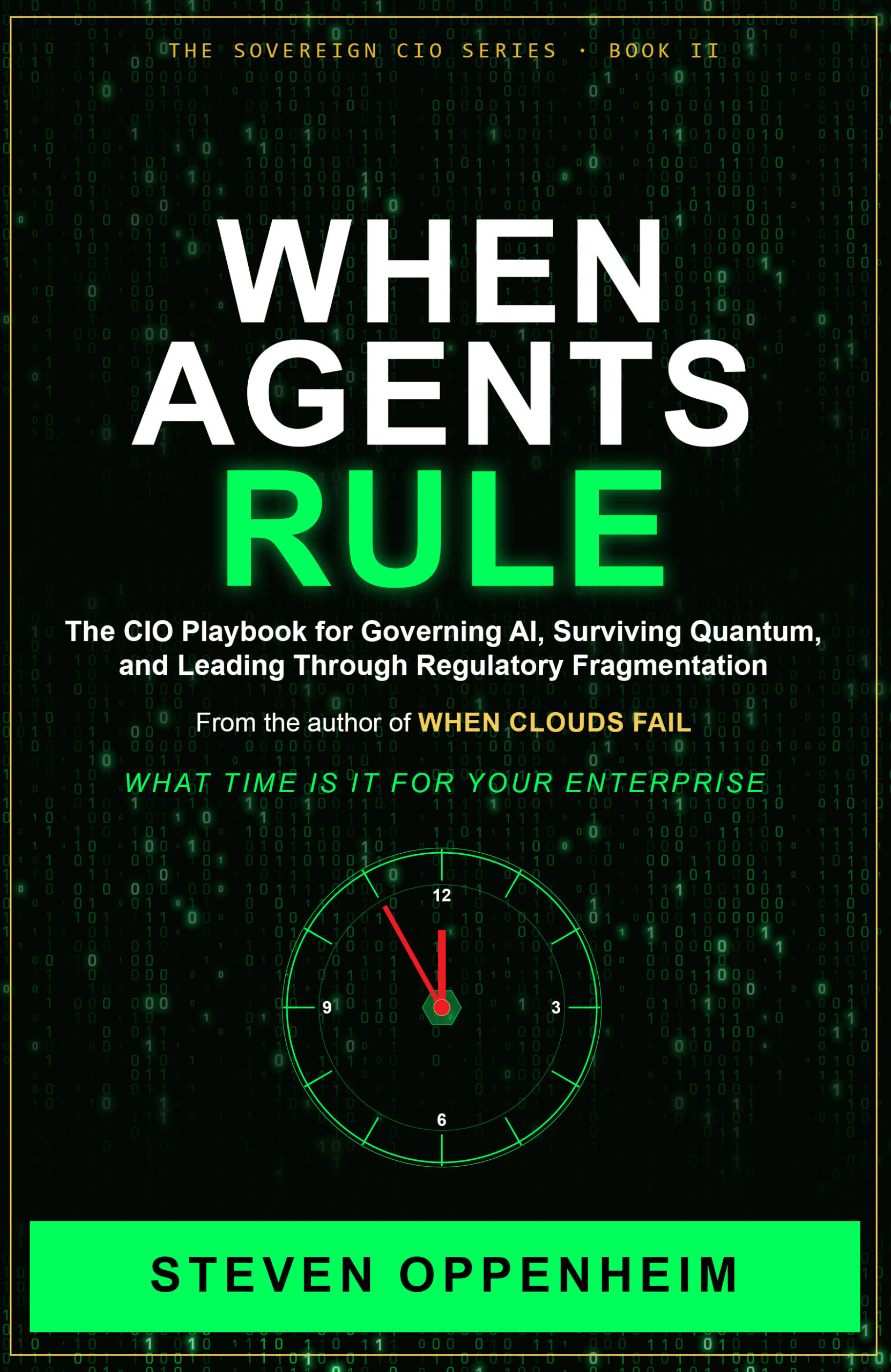
When Agents Rule
The Executive Playbook to Govern Autonomous AI, Defeat the Quantum Threat, and Lead Through Regulatory Fragmentation
You think you are in control. You are not. The crisis will come. The question is whether you have already built the answer.
For the CIO who carries accountability for outcomes that no governance framework yet covers. For the CISO calculating how many years of encrypted data adversaries already hold. For the board member who wants to ask better questions before a crisis makes them irrelevant.
Twenty Eight Things Have Moved Since This Book Went to Press
Four of them correct a figure printed in the book, and those are published in their own table rather than buried. Thirteen did not exist when the manuscript closed. Below are the four with the nearest consequences. The full log is a separate page, because a playbook is only useful if the calendar behind it stays current.
FIPS 140-2 sunsets in six days
All remaining FIPS 140-2 certificates move to Historical status. From that date only FIPS 140-3 validated modules may be used for new United States federal procurement, so validation status determines market access. It is also the cheapest test of whether your cryptographic inventory is real: if you cannot say today which modules are on 140-3, you have a list rather than an inventory.
New since publication. Extends Chapters 6 and 13.
The federal quantum date is 2030, not 2035
Executive Order 14412 sets 31 December 2030 for key establishment and 31 December 2031 for signatures on federal high value assets, and directs the Federal Acquisition Regulatory Council to require contractor compliance by 2030. The book uses 2035 as the anchor. It remains the outer horizon but it is no longer the planning date, and a plan built to 2035 in a federal supply chain has five fewer years than it assumes.
Corrects Chapters 2, 6 and 13. Re run the Quantum Shelf Life Calculator at 2030.
Four dates moved, and Article 50 was not one
The Digital Omnibus was adopted as Regulation (EU) 2026/1744 and moved exactly four dates: Annex III to December 2027, Annex I to August 2028, national sandboxes to August 2027, and content marking for systems already on the market to December 2026. Article 50 transparency applied on schedule in August 2026 and is enforceable now. Chapter 7 predicted the outcome; the log sharpens the Article 50 wording.
Confirms and corrects Chapter 7. Test one system with the Deadline Checker.
The autonomy ladder is now the analyst position
Gartner predicts that by 2027 forty percent of enterprises will demote or decommission autonomous agents because of governance gaps found only after production incidents, and recommends classifying agents by autonomy level with different controls at each level. Its stated root cause is treating governance as binary, either locked down or fully trusted. That is the argument this book makes, reached independently.
Confirms Chapters 4, 5 and 12. A second citation to place alongside the first.
The log carries every entry by strand, a corrections table naming what the book now gets wrong, a section on what has not changed, and the method used to maintain it. Every entry is dated and sourced, survey figures are labelled as survey figures, and enacted law is never blurred with forecast. Treat all of it as a pointer to primary sources rather than a substitute for them, and not as legal advice.
Three Crises, One Convergence
These crises do not announce themselves. They accumulate. By the time most organizations recognize the pattern, the gap between their posture and what is required has grown into something that cannot be closed quickly.
AI Agents Without Governance
Agents are making consequential decisions across your enterprise without governance, audit trails, or accountability. The illusion of control breaks the moment a board asks who approved what. The eighth commitment exists because most of what is operating was never authorized.
The Quantum Countdown
Adversaries are harvesting encrypted data today, waiting for quantum computers to decrypt it tomorrow. If your data must stay confidential for longer than your migration will take, the exposure already exists and no future effort closes it retroactively.
The Fractured World
Regulatory frameworks are fragmenting across more than 140 jurisdictions in ways that turn today’s compliance into tomorrow’s liability. What works in one geography triggers a violation in another, and the dates move in both directions.
The Sovereignty Clock
One diagnostic measures four dimensions of organizational vulnerability. The question is not whether the clock is running. It is. The question is what time it shows for your enterprise.
Clock
Four Quadrants. One Honest Reading.
Most enterprises have at least one quadrant approaching midnight. The Sovereignty Clock is the headline diagnostic of the book: the single instrument a reader should leave carrying. Four quadrants, one question each.
- Agent Governance: Inventory, classify, govern, escalate
- Quantum Countdown: Census, prioritize, migrate, validate
- Regulatory Compliance: Map, classify, document, monitor
- Sovereignty Erosion: Identify, diversify, exit, rebuild
Five Frameworks, Read in This Order
The frameworks in this book are not coequal. Read them in order of priority and the architecture becomes clear.
The Framework Hierarchy
- The Sovereignty Clock is the headline diagnostic. Four quadrants, one question per quadrant. It frames every other framework in the book.
- The L0 to L5 Autonomy Ladder is the classification instrument. Every AI system sits on the ladder, and every governance decision starts there.
- The PLACE Framework is the placement discipline. Every workload answers its five questions before it gets infrastructure.
- Cost Per Compliant Decision is the financial metric. The single number that translates governance discipline into language a CFO will fund and a board will track.
- The A.R.T. Framework, the Eight Commitments and the Friday Afternoon Test are the supporting instruments. Each has its place. None carries the headline.
The L0 to L5 Agent Autonomy Ladder
Six levels of autonomy, from rule based automation to fully autonomous operation. A common language for technical and non technical stakeholders that maps directly to governance intensity. The step from L2 to L3 is the one that matters, because that is where the human stops seeing the work.
The PLACE Framework
Placement, Latency, Accountability, Compliance, Economics. Five questions answered before any workload is assigned infrastructure, so placement decisions become auditable, defensible and reversible rather than architectural folklore.
Cost Per Compliant Decision
Everything spent making an autonomous decision defensible, divided by the decisions that clear the bar. It behaves like cost per transaction, which means a finance function already knows what to do with it. Governance stops being a cost line and becomes unit economics.
The A.R.T. Framework
Agility, Risk Readiness, Tenacity. The three organizational capabilities that separate the technology leaders who navigate convergent crises from those caught between them. Operational rather than aspirational, and diagnosable.
The Eight Commitments of the Sovereign CIO 2.0
A leadership covenant designed to endure beyond any single technology cycle, from agent visibility to institutional legacy. The constitution of the technology executive who refuses to be replaced by their own systems.
The Friday Afternoon Test
The diligence model that separates governance documentation from governance enforcement, paired in Chapter 16 with the board companion framework and the five questions a director should put to a CIO.
The organizations that win the next decade will not be those with the most advanced AI. They will be those with the most disciplined governance. Sovereignty is not a constraint on innovation. It is the foundation that makes innovation durable.
When Agents Rule, Executive OverviewThe Eight Commitments of the Sovereign CIO 2.0
Chapter 16 turns the frameworks into a covenant. Eight statements a technology executive should be willing to sign and be measured against.
I will know what AI agents operate in my enterprise.
I will govern AI commensurate with its autonomy.
I will prepare for quantum threats before they arrive.
I will design for regulatory evolution, not regulatory stasis.
I will maintain sovereignty over critical capabilities.
I will translate technical necessity into business language.
I will build capabilities that persist beyond my tenure.
I will find the AI I did not authorize.
The eighth commitment is the one the book argues matters most. A commitment to govern what you can see is worthless if most of what is operating is invisible. Discovery is the precondition for every other commitment on the list, which is why the toolkit below opens with an inventory instrument and a shadow AI discovery log rather than with a policy.
Four Ways to Read Seventeen Chapters
The book is built to be entered at the point where your crisis already is. Pick the path that matches the time you actually have.
The Time Pressed Executive
15 to 30 minutesStart with the Executive Brief, which distils the whole book into its frameworks, figures and action items. Then run the Monday Morning Checklist at the end of it, which gives you five moves for five days.
Executive Brief, then the checklist
The CIO or Technology Leader
2 to 3 hoursIntroduction, then Chapters 1 to 3 for the threat landscape, then Chapter 15 for the operating model and Chapter 16 for the commitments. Return to Chapters 4 to 8 and 9 to 13 as implementation demands.
1 to 3, then 15, 16, 17
The Architect or Program Lead
Full readSequential, Introduction through Chapter 17. The three strands alternate by design, because agents, quantum and fragmentation do not arrive in sequence in a real enterprise. They arrive together, on one desk, in one quarter.
Introduction to Chapter 17
Board and Non Technical Executives
Selected chaptersExecutive Brief, Chapter 10 on the return on governance investment, Chapter 11 on quantum economics, Chapter 16 for the commitments and the board companion framework, and Chapter 17 for the identity the work requires.
Brief, 10, 11, 16, 17
Reading by topic instead? Agent governance is Chapters 1, 4, 5, 10 and 12. Quantum readiness is 2, 6, 11 and 13. Regulatory compliance is 3, 7, 8 and 14. Business case development is 10 and 11.
Diagnostic Tools for the Sovereign CIO
Eight interactive instruments, all of them live. Read your clock, classify your agents, price your governance, score your bill of materials, and find out whether your governance would survive somebody asking to see it. Nothing is transmitted or stored by any of them.
Sovereignty Clock Reader
Score your enterprise across all four quadrants. Find out which clock hand sits closest to midnight and where to move first.
7 minutes Read the ClockL0 to L5 Agent Classifier
Classify any AI system by operational autonomy. Get the matched governance tier, oversight controls and escalation rules for that level.
4 minutes Classify an AgentCost Per Compliant Decision Calculator
Price your governance as unit economics. Produces the do nothing trajectory, the governed trajectory, and the present value cost of waiting a year.
6 minutes Price the DecisionQuantum Shelf Life Calculator
Enter how long your data must stay confidential and how long your migration will take. Returns your protection margin in years, and whether the exposure already exists.
3 minutes Calculate ExposureA.R.T. Capability Assessment
Score your organization on Agility, Risk Readiness and Tenacity. Identify which capability is the binding constraint and what to invest in next.
6 minutes Assess CapabilityEU AI Act Deadline Checker
Six questions about one system, plus a short context block, and you get the dates that actually apply to it after the 2026 amendments, with what was deferred separated from what was not. Includes your penalty ceiling in euro.
4 minutes Check The DatesThe Friday Afternoon Test
Five dimensions, each scored twice: is the control designed, and could you evidence that it operated this afternoon. The gap between those two numbers is the answer, because a control that is designed and not operating reports green.
3 minutes Take the TestAIBOM Readiness Scorer
Twenty two checks across the six categories, plus format, signing and generation. Returns the weakest category rather than the average, the time to produce an Annex IV file on request, and whether you would clear a vendor qualification.
8 minutes Score Your ReadinessThe Free Companion Toolkit
Twenty two instruments in four groups, all live. Working registers, scored checklists, financial models, runbooks and board papers, built to be filled in rather than read. Three were added in September 2026 after an industry review found artefact requirements the original nine did not cover.
Start with the Toolkit Index. Twenty two instruments is too many to begin with, and the index says so: the ninety day sequence starts four of them and deliberately produces no policy at all in the first thirty days, because a policy written before the inventory governs the systems you already knew about. The index also carries the reconciliation table that names which instrument is authoritative when two of them disagree about the same figure.
Free for internal use inside your own organization. Not legal, technical or financial advice.
Agent Governance
5 LiveQuantum Readiness
5 LiveRegulatory and Sovereignty
7 LiveExecution, Finance and Leadership
5 LiveBe told when the calendar moves
Three dates in this book changed within seven months of publication. One of them changed six days before it was due to take effect. If you would rather not find that out from a regulator, subscribe and you will get the update and the revised register.
Marked in the source as REPLACE_NEWSLETTER_FORM.

Questions Readers Ask First
Short answers. The long answers are in the chapters named.
Do I need to read When Clouds Fail first?
No. When Agents Rule stands alone. Readers of the first book will recognize the sovereignty and financial discipline themes continuing, and the frameworks build on that foundation, but nothing here assumes you have read it.
Is this a technical book or an executive book?
Executive, with enough technical specificity to survive a conversation with an architect. The financial models in Chapters 10 and 11 are built for a CFO’s scrutiny, and the implementation roadmaps in Chapters 12 and 13 are built for organizational resistance rather than for a whiteboard.
The EU deferred its AI rules. Has the urgency gone?
No, and this is the most costly misreading available in 2026. The Digital Omnibus was adopted as Regulation (EU) 2026/1744 and moved exactly four dates: Annex III high risk to December 2027, Annex I to August 2028, national sandboxes to August 2027, and content marking for systems already on the market to December 2026. Everything else kept its date. Article 50 transparency applied in August 2026 and is enforceable now, the penalty regime has been live since August 2025, and the AI literacy duty has applied since February 2025. Two new prohibitions arrive in December 2026. Treating the whole regime as delayed means missing three live obligation sets while gaining time on one deferred set. The EU AI Act Deadline Checker runs this distinction against one of your own systems and tells you which of your dates have already passed.
The book was published in 2026. How current is it now?
The manuscript closed in mid 2026 and the Since Publication log tracks everything that has moved since, currently twenty eight dated entries. Four of them correct a figure printed in the book and they are listed in their own table rather than buried: the breach cost figure, the characterisation of Article 50, the federal post quantum planning date, and an additional Gartner prediction to cite alongside the existing one. The frameworks themselves have held, and in one case been independently arrived at by Gartner, which now recommends classifying agents by autonomy level and governing each level differently.
Are the composite executives in the book real people?
No. They are composite figures drawn from a quarter century of advisory work across industries and continents, and the book says so explicitly. Their situations are true in essence rather than in detail, and no character represents a single individual or organization.
Can I use the toolkit inside my company, and can I share it?
Yes to internal use, including adapting the templates for your own organization. All twenty two instruments are provided free for that purpose. For redistribution, training delivery or commercial use, see the usage policy linked below. None of it is legal, technical or financial advice, and the regulatory dates should be verified with your own counsel.
Twenty two instruments is a lot. Which ones actually matter?
Four, to begin with, and the Toolkit Index names them: the Agent Inventory, the Cryptographic Census, the FIPS 140-3 sheet in the Cryptographic Bill of Materials workbook, and the Regulatory Obligation Register. The first thirty days of the ninety day sequence deliberately produce no policy at all, because a policy written before the inventory governs the systems you already knew about rather than the ones that will cause the incident. The remaining eighteen instruments each answer a question you will not have until those four are populated.
Where do I start if I only have one hour?
Read the Executive Brief, run the Sovereignty Clock Reader above, and download the Agent Inventory workbook. That combination tells you which of the four quadrants is closest to midnight and gives you the register to start filling in. If you have a second hour, take the Friday Afternoon Test above. It scores five dimensions twice, once for what is designed and once for what you could evidence this afternoon, and the gap between those two numbers tells you whether what you have is governance or a document about governance.
The Clock Is Already Running
Get the book, read your clock, download the toolkit, or ask about an advisory engagement.
The eight diagnostics, in quadrant order